Boosting JSON.stringify: V8's Optimizations for Faster Serialization
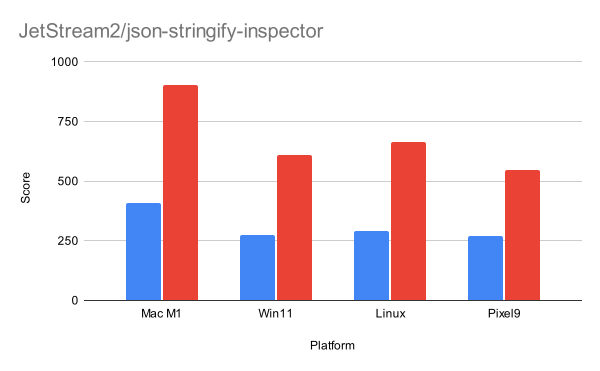
JSON.stringify is a cornerstone of JavaScript, used everywhere from transmitting data over the network to saving state in localStorage. Speed matters. A recent overhaul in V8, the JavaScript engine powering Chrome and Node.js, has doubled the performance of JSON.stringify. This Q&A explores the technical innovations behind this leap, including a new fast path, iterative architecture, and string encoding optimizations.
1. What was the key optimization that made JSON.stringify more than twice as fast in V8?
The primary breakthrough was the introduction of a side-effect-free fast path. The old general-purpose serializer had to handle all possible scenarios, including user-defined toJSON() methods, getters, Proxy objects, and potential garbage collection triggers. Each of these required costly runtime checks and fallback logic. The new fast path is only used when V8 can prove that serializing a given object will not cause any side effects—meaning no user code runs, no hidden state changes, and no GC triggers during traversal. When this guarantee holds, V8 can skip nearly all the defensive boilerplate and execute a lean, optimized routine. This simple change yielded a dramatic speedup for the most common use cases: plain objects, arrays, strings, numbers, and booleans. For typical data shapes seen in web apps, the serializer now runs over twice as fast as before.
2. How does V8 determine if serialization can use the fast path?
V8 performs a runtime check on the object's structure and the overall serialization context. It verifies that none of the object's properties are defined with getters or setters, that the object doesn't have a custom toJSON() method on its prototype chain, and that no Proxy objects are involved. Additionally, it checks that the object's elements (array indices) are all simple values and that the object is not a Function or other exotic type. If any of these conditions fail, the serializer falls back to the slow, safe path. The fast path uses a type-checking mechanism that inspects the hidden class (map) of the object to confirm it's a plain dictionary-like structure. Because modern JavaScript engines heavily optimize object shapes, this check is extremely cheap. In practice, most JSON data passes these tests, making the fast path the default for typical use. For more details on what can block the fast path, see Limitations.
3. What advantages does the new iterative architecture provide over the recursive one?
The previous serializer used recursion to traverse object graphs. While straightforward, recursion has inherent costs: each recursive call adds a stack frame, which can cause stack overflows for deeply nested objects, and requires frequent checks for stack depth. The new fast path uses an iterative approach with an explicit stack (a JavaScript array or a C++ vector). This change brings several benefits. First, it eliminates stack overflow errors for deep nesting, since the manual stack can be expanded on the heap. Second, it significantly reduces the overhead of function calls—the hot loop runs in a single method without pushing and popping frames. Third, it allows V8 to pause and resume serialization efficiently, which is useful when encoding changes are needed (e.g., switching between string representations). As a result, the iterative path is not only faster but also more robust for extreme data structures.
4. How does V8 optimize for different string encodings?
Strings in V8 can be either one-byte (ASCII-compatible) or two-byte (UTF-16). A single non-ASCII character forces the entire string into two-byte mode, doubling memory usage. To avoid runtime branching on every character, the serializer was templatized on the character type. V8 compiles two separate, specialized versions of the fast-path stringifier: one that assumes all strings are one-byte and another for two-byte. Each version uses optimized loops without conditionals for character width. When serializing a particular object, V8 checks the instance type of each string to decide which version to use. If a string contains mixed encodings (e.g., a two-byte substring within a one-byte flow), the system may fall back to the slow path or handle it via conversion. Templatization increases binary size but pays off in throughput—especially for the common case of pure ASCII JSON data.
5. What is templatization, and how does it benefit the serializer?
Templatization is a technique where a generic algorithm is instantiated multiple times, each version optimized for a specific data type. For JSON.stringify, V8 creates two distinct implementations of the fast path stringifier—one for one-byte strings and one for two-byte strings. This avoids the overhead of checking the character width in every inner loop iteration. Instead, each version uses tight loops with unrolled operations that match the character size. The trade-off is increased binary size (two copies of similar code), but the performance gain justifies it. This approach mirrors how V8 optimizes many other built-in functions—like String.prototype.indexOf—by compiling multiple specialized variants. For JSON.stringify, the benefit is especially pronounced since string encoding checks occur frequently during serialization of object keys and values.
6. What are the limitations of the fast path? When does it fall back?
The fast path cannot be used when serialization would trigger side effects. Common triggers include: objects with toJSON() methods that execute arbitrary code; properties defined via getters (which run code on access); Proxy objects that can intercept property access; and objects that require a garbage collection (GC) cycle, such as ConsString that need flattening (because flattening may allocate memory and trigger GC). Also, if the object graph contains circular references, the fast path will detect the cycle and fall back to the general serializer that can handle it with a `Set` to track visited objects. In practice, most simple data objects—like those produced by JSON.parse or plain object literals—qualify for the fast path. Developers can help maintain fast-path eligibility by avoiding getters, toJSON, and Proxy in their data structures.
7. How does this performance improvement affect real-world applications?
For everyday web apps, JSON.stringify is a hotspot in data-heavy operations: sending AJAX payloads, storing to localStorage, serializing state for Web Workers, or formatting logs. Doubling the speed means faster page loads, smoother interactions, and lower CPU usage. For instance, an e-commerce site that serializes a cart with dozens of items will see reduced latency before sending to the server. A charting library converting a large dataset to JSON for rendering will refresh more responsively. The improvement also benefits Node.js services that parse request bodies or produce JSON responses. Since the fast path works with the most common data shapes, most developers will see a noticeable speedup without any code changes. This optimization is part of ongoing work to make V8's built-in functions approach native code performance, directly improving user experience across the Chrome ecosystem.