Microsoft Unveils ConferencePulse: .NET's Composable AI Stack Powers Real-Time Conference Assistant
Microsoft Unveils ConferencePulse: .NET's Composable AI Stack Powers Real-Time Conference Assistant
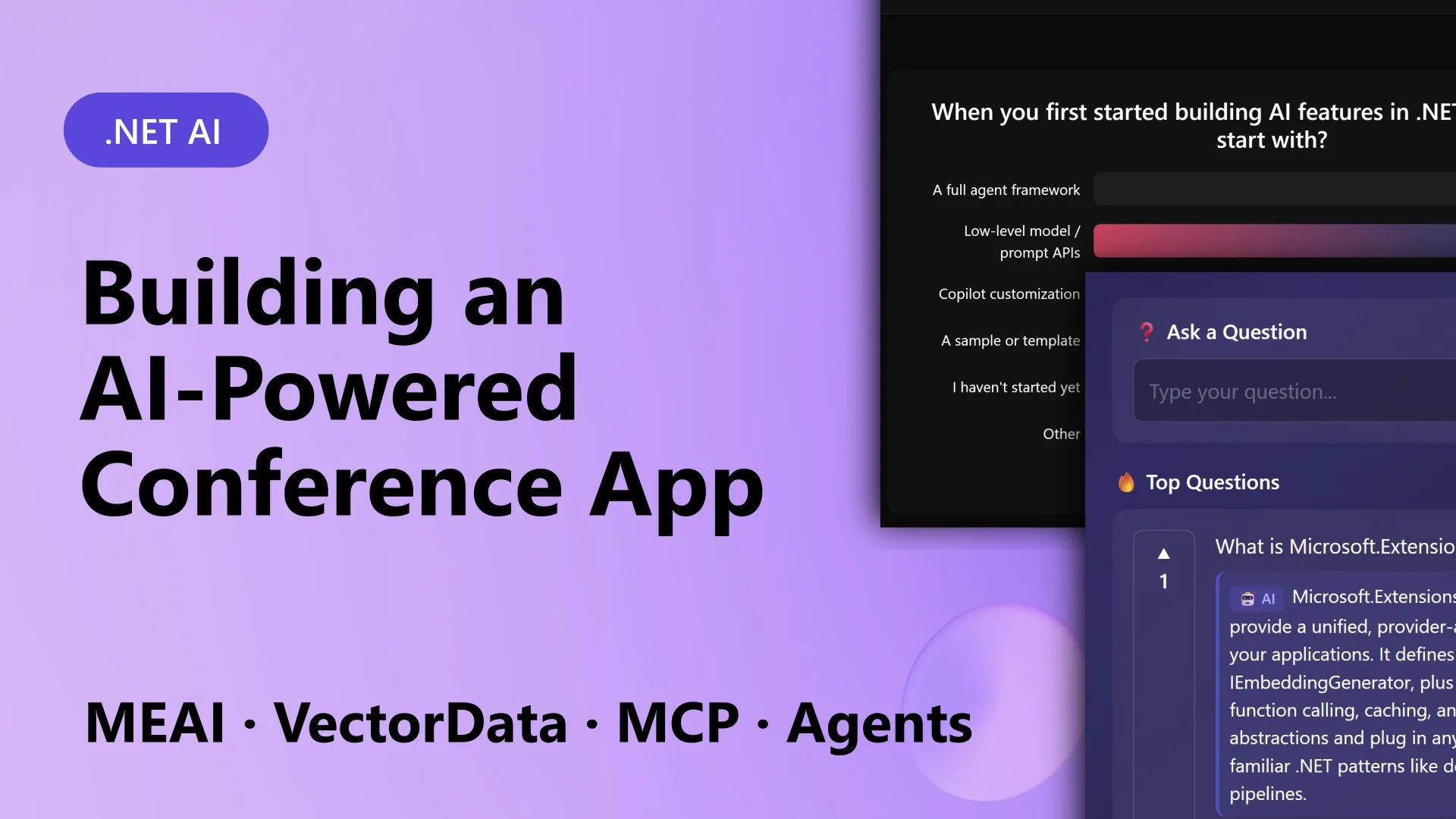
REDMOND, WA — Microsoft today demonstrated a new reference application, ConferencePulse, built entirely on its composable .NET AI stack. The app handles live polling, real-time Q&A, session insight generation, and automated summarization — all while attendees interact via QR code and a Blazor Server front end.
The app was created for MVP Summit, where it served as both a live tool and a technology showcase. “We wanted an interactive session, not a slide deck,” said a Microsoft engineer involved in the project. “ConferencePulse let us demonstrate how these building blocks work together in a real-world scenario.”
How ConferencePulse Works
Attendees scan a QR code to join a session. The AI then generates polls based on the session’s content, answers audience questions via a retrieval-augmented generation (RAG) pipeline, and surfaces engagement patterns in real time. When the session ends, multiple AI agents collaborate to produce a comprehensive summary.
The backend leverages five key components from Microsoft’s extensible AI ecosystem: Microsoft.Extensions.AI, Microsoft.Extensions.DataIngestion, Microsoft.Extensions.VectorData, Model Context Protocol (MCP), and the Microsoft Agent Framework. “Each building block addresses a different pain point,” the engineer explained. “Extensions.AI gives us a unified IChatClient that works across OpenAI, Azure OpenAI, Ollama, and others — without rewriting code.”
Technology Stack
- ConferenceAssistant.Web – Blazor Server (UI + orchestration)
- ConferenceAssistant.Core – Models, interfaces, session state
- ConferenceAssistant.Ingestion – Data ingestion pipeline + vector search
- ConferenceAssistant.Agents – AI agents, workflows, tools
- ConferenceAssistant.Mcp – MCP server tools + MCP client
- ConferenceAssistant.AppHost – .NET Aspire (Qdrant, PostgreSQL, Azure OpenAI)
The app runs on .NET 10 and is orchestrated by .NET Aspire. It ingests content from a GitHub repo, processes markdown into a searchable knowledge base, and grounds every poll and answer in that content.

Background: The Fragmentation Problem
Historically, adding AI to .NET apps meant stitching together models, vector databases, ingestion pipelines, and agent frameworks from different ecosystems. Each brought its own patterns, client libraries, and breaking changes. “Developers often spent more time wrestling with abstraction mismatches than building features,” a Microsoft product manager noted.
The new composable stack provides stable abstractions across all these concerns. Microsoft.Extensions.AI unifies AI providers; Microsoft.Extensions.DataIngestion standardizes document processing; Microsoft.Extensions.VectorData abstracts vector stores; MCP enables tool integration; and the Agent Framework coordinates multi-agent workflows.
What This Means for Developers
ConferencePulse is a proof point that .NET developers can now build sophisticated AI applications without leaving the .NET ecosystem. “You don’t need to become an expert in every AI service,” the engineer said. “These building blocks handle the plumbing, so you can focus on the user experience.”
The approach also simplifies maintenance. Because each component uses standard interfaces, upgrades or provider swaps require minimal code changes. “When Azure OpenAI releases a new client version, your app doesn’t break — because it’s talking to IChatClient, not to the provider directly,” the engineer added.
Microsoft plans to open-source these libraries in the coming months, making them available via NuGet. Early adopters can expect a smoother path to production for AI features — from chatbot assistants to real-time analytics.
“ConferencePulse shows what’s possible when you have a consistent, extensible AI stack,” the engineer concluded. “We’re excited to see what the community builds with it.”