Rethinking the American Dream: A Conversation on Democracy and Opportunity
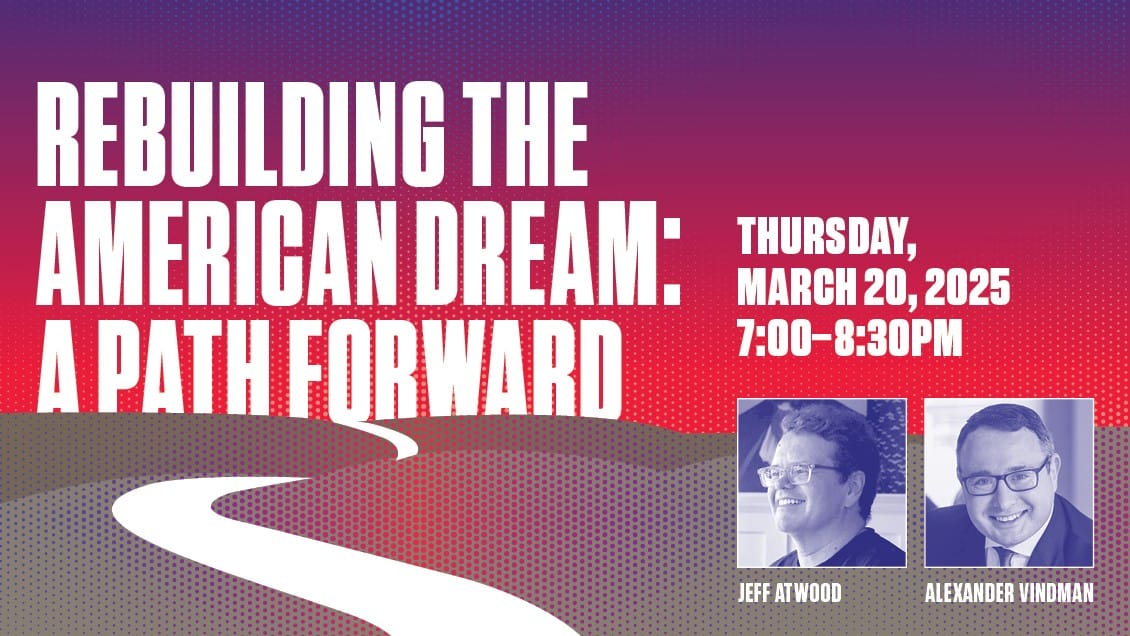
In an upcoming talk at Cooper Union Great Hall, two advocates from vastly different backgrounds will sit down to explore what the American Dream means today. The author, a technology entrepreneur and community builder, along with Colonel Alexander Vindman, a decorated veteran and former National Security Council official, will discuss how we can strengthen democracy, foster economic mobility, and create systems that work for everyone. This Q&A unpacks the key ideas from that discussion.
What is the American Dream in 2025?
The American Dream has long been defined as the promise that hard work, fairness, and opportunity can lead to a better future. But in 2025, that promise feels more like a question: Can we build a dream that actually works for everyone? The core values remain—effort, equity, and hope—but the path to achieving them must adapt. We must move beyond believing that individual grit alone is enough and instead design systems that provide security, dignity, and possibility for all. This means rethinking how we structure our economy, our communities, and our democratic institutions, ensuring that they support not just the fortunate few but every person willing to contribute.
Who is Alexander Vindman, and why is his story important?
Alexander Vindman was born in the Soviet Union and immigrated to the United States as a child, growing up in Brooklyn before enlisting in the U.S. Army. Over 21 years, he served with distinction, earning a Purple Heart after injuries sustained in Iraq and rising to become Director of European Affairs for the National Security Council. When faced with a choice between loyalty to a political agenda and upholding the Constitution, he chose integrity—a decision that ended his career but cemented his legacy. His willingness to put everything on the line for democratic ideals embodies the very essence of civic courage, reminding us that the American Dream is not just about personal success but about defending the principles that make it possible for everyone.
What is the author’s background and how does it relate to the American Dream?
The author builds communities online—notably as a co-creator of Stack Overflow and Discourse—and writes extensively about how people interact in digital spaces. Years of observing forums, social platforms, and collaborative tools have taught them that clear expectations, fair systems, strong boundaries, and a shared sense of purpose are essential for any community to thrive. These same principles apply to society at large. The author believes that by focusing on structural change—not just individual generosity—we can create systems that provide security, dignity, and opportunity for everyone. Their journey from digital community builder to advocate for systemic reform is a testament to the evolving nature of the American Dream itself: it must be constantly reimagined to stay relevant.
What key themes will be explored at the Cooper Union talk?
The talk will center on three interconnected pillars: democracy, community, and economic mobility. Through their different lenses, Vindman and the author will examine how defending democratic institutions, strengthening local and digital communities, and creating equitable pathways to prosperity can reinvigorate the American Dream. They will discuss real-world examples of systemic change and the hard conversations needed to move forward. The goal is not to offer neat answers but to spark an honest, unflinching dialogue about what we owe each other and how we can build a country where hard work and fairness truly lead to a better future for all.

How can we move beyond individual generosity to create lasting systemic change?
Individual generosity—donating to charity, volunteering, helping a neighbor—is valuable, but it alone cannot fix deep-rooted structural inequalities. To create lasting change, we need to redesign the systems that govern our lives: education, healthcare, housing, and the economy. This means advocating for policies that ensure equal access to opportunity, building institutions that are transparent and accountable, and fostering cultures that prioritize collective well-being over narrow self-interest. The author argues that the same principles that make online communities work—clear rules, fair moderation, shared ownership—can be applied offline. For example, public goods like local parks are enjoyed by everyone, reflecting a commitment to common benefit. By focusing our efforts on these foundational systems, we can create an environment where security, dignity, and possibility are not privileges but rights.
What does 'staying gold' mean in the context of the American Dream?
Staying gold is about holding onto the best parts of ourselves, our communities, and the American Dream—even when it’s hard. It’s not a passive state; it requires constant work, action, and honest conversations that ask us to confront where we’ve been, where we are, and who we want to become. In the face of cynicism or corruption, staying gold means choosing integrity over convenience, community over isolation, and hope over despair. For Alexander Vindman, that meant risking his career to testify truthfully. For the author, it means using digital tools to build spaces that encourage fairness and constructive discourse. Ultimately, staying gold is the active, collective responsibility to protect the dream for everyone, not just ourselves.