Scaling Data Wrangling: From Preparation Pitfalls to AI-Ready Workflows
Data wrangling—also known as data munging—is the process of transforming raw data into a usable format for analysis or machine learning. While critical, it consumes most data practitioners' time, leaving little for actual modeling that drives business value. When done haphazardly across teams, it becomes a bottleneck for AI initiatives. This Q&A explores the core challenges of data wrangling at enterprise scale and how organizations can build governed, reusable, and AI-ready pipelines.
1. Why is data wrangling a bottleneck for enterprise AI?
Data practitioners typically spend 60–80% of their time on data preparation tasks like cleaning, transforming, and structuring data. For a single project, this reduces time for analysis and modeling, already a productivity issue. At enterprise scale, when dozens of teams independently wrangle data using different tools, naming conventions, and quality thresholds, the problem multiplies. Each team’s preparation workflow becomes a silo, leading to inconsistent datasets and duplicated effort. As a result, the business struggles to launch machine learning models, generative AI applications, or AI agents quickly because the foundational data isn’t ready. This bottleneck stalls every AI initiative the business attempts, turning a productivity issue into a strategic risk.
.png)
2. What risks arise from inconsistent data preparation across teams?
When teams prepare data independently without shared standards, the enterprise faces three major risks. First, model accuracy suffers: models trained on differently prepared data produce unreliable or contradictory predictions. Second, compliance gaps surface during audits because no one can verify that regulatory requirements (like GDPR or HIPAA) were followed consistently. Third, decision-making becomes untraceable: business decisions based on datasets that cannot be fully traced back to their source or transformation steps are risky. Moreover, these risks compound when multiple teams reuse each other’s data without understanding the preparation logic, leading to downstream errors that are hard to diagnose. The result is a fragmented data landscape that undermines trust in AI outputs.
3. How does generative AI amplify data preparation issues?
Generative AI and agentic systems amplify whatever is in the data they consume. If the underlying training or operational data has been wrangled inconsistently, the model will generate confident but flawed outputs. For example, a chatbot trained on customer data with missing or misaligned fields may produce inaccurate responses. Worse, agentic systems—which autonomously execute decisions—can act on undocumented preparation logic, making it nearly impossible to audit outcomes. These systems take raw preparation errors and turn them into real-world actions, magnifying the impact of small data mistakes. Without governed, repeatable data preparation, enterprises risk deploying AI that produces harmful or non-compliant outcomes at scale.
4. What is data wrangling and why is it important for AI?
Data wrangling (or data munging) is the process of gathering, selecting, transforming, and structuring raw data into a format suitable for analysis or model training. It includes cleaning missing values, normalizing formats, merging datasets, and feature engineering. Its importance lies in the fact that AI systems are only as good as their data. Poorly wrangled data leads to biased models, incorrect insights, and failed deployments. At enterprise scale, wrangling ensures that data from diverse sources (databases, APIs, logs, etc.) is consistent, accurate, and ready for consumption by machine learning pipelines. Without it, even the most advanced algorithms cannot produce reliable results. Therefore, investing in proper data wrangling practices is a prerequisite for successful AI enablement.
5. What modern approaches help govern data preparation at scale?
To overcome chaos, enterprises adopt governed data preparation platforms that provide centralised metadata management, version control, and automated validation. Key approaches include:
- Declarative pipelines: Define transformation logic in a reusable, auditable way rather than in ad-hoc scripts.
- Data catalogs: Tag and document datasets with lineage, quality scores, and usage rights.
- Automated quality checks: Set rules (e.g., not null, unique) that run before data enters the training pipeline.
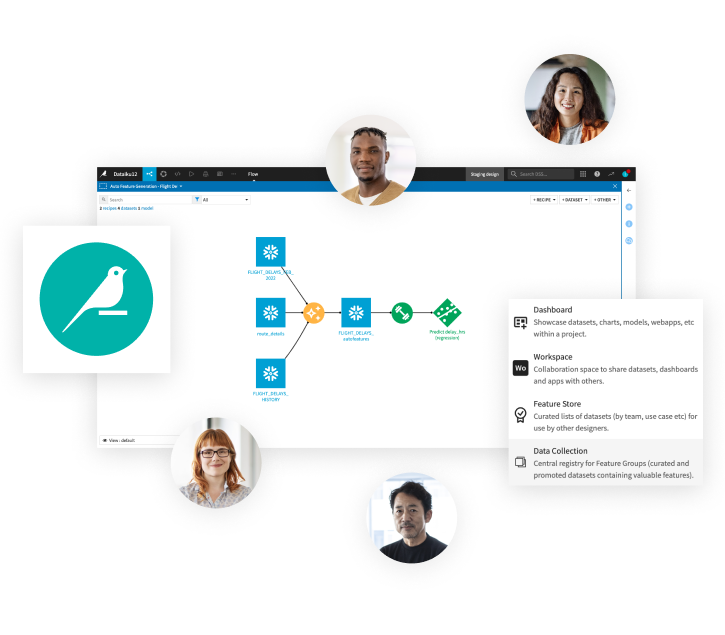
- Collaborative workspaces: Allow teams to share wrangling steps and reuse proven transformations.
These approaches shift data preparation from a manual, siloed activity to a transparent, scalable function. They also enable traceability: every transformation can be traced back to its source, helping auditors and data scientists understand how the final dataset was produced.
6. How can organizations make data preparation reusable across teams?
Reuse requires standardisation and abstraction. Start by creating a central repository of data preparation templates—common cleaning routines, join patterns, and feature engineering functions—that any team can import. Use parameterised workflows that allow teams to adapt templates for their specific datasets without rewriting logic. Also, implement a data product mindset: treat prepared datasets as reusable assets with documented schemas, quality metrics, and ownership. When teams produce “blessed” datasets, others can reuse them with confidence. Version control (e.g., Git-like versioning for data) ensures that downstream consumers can reproduce any earlier state. By fostering a culture of sharing and codifying best practices, enterprises minimise duplicated effort and accelerate AI development while maintaining governance.
7. What role does traceability play in data wrangling for enterprise AI?
Traceability—the ability to follow data from its origin through every transformation to its final form—is crucial for trust and compliance. In regulated industries, auditors require proof that data used in AI models was prepared according to policies. Without traceability, teams cannot answer “How was this dataset created?” or “Which transformations were applied?” This uncertainty introduces risk, especially when models make autonomous decisions. Modern data wrangling tools embed lineage tracking that automatically records each step: source ingestion, cleaning, feature creation, and export. When a model behaves unexpectedly, data scientists can backtrack through the lineage to identify preparation errors. For generative AI, traceability helps verify that training data wasn’t contaminated or misaligned. Ultimately, traceability turns data preparation from a black box into a transparent, auditable process that builds confidence in AI outputs.